Memory Palace
April & October 2018
Workshop 2 - 5 April 2018
Exhibition 11 - 28 October 2018
GAMU (Gallery AMU), Prague


Memory Palace is a collaborative project focussing on ways of creating and collaboration. Together with a group of international post-graduate students from various artistic fields (photography, stage design, animation and choreography) Captain Lightfoot explore methods that allow us to create works. The resulting exhibition will be shown at GAMU (The Gallery of the Academy of Performing Arts in Prague) in October 2018.
At least since Wagner’s idea of Gesamtkunstwerk, which dates back more than 150 years, generations of artists have been attracted by the innovative potential of bringing together different art forms. Nowadays, interdisciplinary research and art practice are ever more popular. For the Scottish artist-run collective Captain Lightfoot (Anneli Holmstrom, Emma Pratt and Kadie Salmon) working in an interdisciplinary, collaborative fashion has become their second nature.
At the core of the Memory Palace project lie questions about the source, forms and limits of human creativity, and—first and foremost—a quest to experiment with the creative processes. Four young artists (Christian Henninger, Nitish Jain, Bára Anna Stejskalová and Eva Urbanová) from the Academy of Performing Arts in Prague were invited to contribute to the project, which was launched by a four-day workshop in April 2018. Intensive artistic research and exchange followed until the Memory Palace exhibition slowly became to take shape.
A big part of the research was directed toward the inter-war avant-garde, drawing inspiration from Dada’s rupturing the link between art and artist’s controlled decision making, Surrealism’s automatic writing and focus on the unconscious, or Moholy-Nagy’s idea of the art object as the catalyst of an interactive event. The technique of "transcendental meditation“—as described and championed by David Lynch—has also served as an important source of ideas for the exhibition, together with sensory deprivation and meditative walks. Memory Palace combines the above mentioned references, while using the vocabulary of contemporary art.
The artworks on show are comprised of a series of fictive audios, photo montages and assemblages of random objects collected by the individual artists during their meditative walks. The architecture of the exhibition is structured as a "memory palace“—an imaginary location in your mind where you can store mnemonic images. It follows a path created in order to store creative inspiration, memories and visual imagery. (Text by Eliška Žáková, Gallery Director).
Curated by: Captain Lightfoot
Graphic design: Jan Slabihoudek
Sound design: Robin Holmberg
Sound Recording: Vojtěch Zavadil
Special thanks to: Matěj Šenkyřík (technical assistance), Viktor Dedek (set-up)
Supported by:
Academy of Performing Arts in Prague, Ministry of Culture Czech Republic, STEP Beyond (European Cultural Foundation)
Media partners: artmap.cz, jlbjlt.net
Installation images


Audio works and Tents
At a pre-organised date and time, all participants of the collaboration interrupted their daily goings on to write automatically for five minutes, allowing the unconscious mind to fill the minutes. The times for this exercise varied from 6pm some days to 3am others; writing in the middle of a restaurant, a house party or concert or woken in the middle of the night still in a dream state of mind. The texts reveal each artist's unconscious mind; a rambling stream of words and sentences, where the nonsensical is crudely interrupted by the intrusion of the conscious voice; questions, self-reflection and awareness. Here the unconscious mind-overlap; feeding one another through creative process. An important part of this writing process was to feel connected to the other participants and to know that they were also doing this at the same time in their respective countries. This body of automatic writings were then shared; with each participant selecting three lines from each other's writings. Each artist then re-structured these lines to create their own version of the collective memory/narrative. These narratives now exist for the viewer as recorded audios. Each audio is housed in an individual 'tent' like structure constructed by each artist. Here the viewer is invited to enter an intimate space, shut off from the gallery surroundings. Listening on headphones, this narrative unravels and memories are conjured; emphasised by sounds, tactility and smells such as rain or a crackling fire.


Photo Montages
Using one 35mm film camera and one spool of black and white film, the artists each took it in turn to photograph their environment and daily lives in their respective countries. This film was rewound and then passed on to the next artist to use; going forward, back and forward again and again until all artists had documented their lives individually without the others present. It is only in the resulting artworks; nine multiple exposure images, that these solo documentations overlap one another; physically exposing the shared nature of the experience.


Found objects/ Meditation
These are an array of found objects that have been collected individually by the artists and manipulated or re-arranged using unconscious techniques such as collage. Each artist in their own country and environment walked for twenty minutes for twenty paces at a time before changing direction; all whilst listening to the same mediation soundtrack. During this relaxed state of mind, walking in environments which included Spanish beach resorts, childhood bedrooms, bustling city centres, junkyards and woodland, the artists collected found objects. Returning to the studio they then transformed these objects into new arrangements using methods devoid of critical thought or analysis; these objects are not artworks that conform to a formal language of fine art but instead exist more like artefacts; tools to tell a story. Each artist then gave their object(s) a title. It is the title that applies meaning to the object; an interpretation or story. Here the conscious mind intervenes to gives reason to these objects created using unconscious techniques. However the interpretation and story does not end with the artist/maker, instead each object has different interpretations, with each artist giving a title to each other's object(s).


Collaborative Choreography
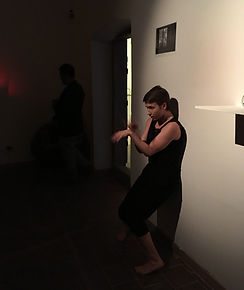
Working with Choreographer and dancer Eva Urbanova we collectively created descriptive prompts to create movements around, with and in response to the tent and audio works.


Exhibition Preparation


Printed handout


Workshops
2 - 5 April 2018
The Academy of Performing Arts & GAMU (Gallery Amu)
Prague
The co-operative stage of the project begun with a 4 day Research workshop held at Gallery Amu and the Academy of Performing Arts; delivered by the collective to the selected participants. The workshop was divided into two sections - firstly focusing on creative processes through the lens of the unconscious mind and secondly, creative actions brought about by the conscious mind. This workshop explored a range of concepts, covering references derived from surrealist methods, deprivation techniques, meditative practices and dream logic, as well as collective workings. A large volume of material and ideas were generated during these 4 days, taking the form of drawings, writing, maquettes/models, improvised movement and audio/video works. Following this, the collaborators have used the research generated to dialogue over six months via Skype and online platforms using this material to inform the production of a collaborative exhibition.


